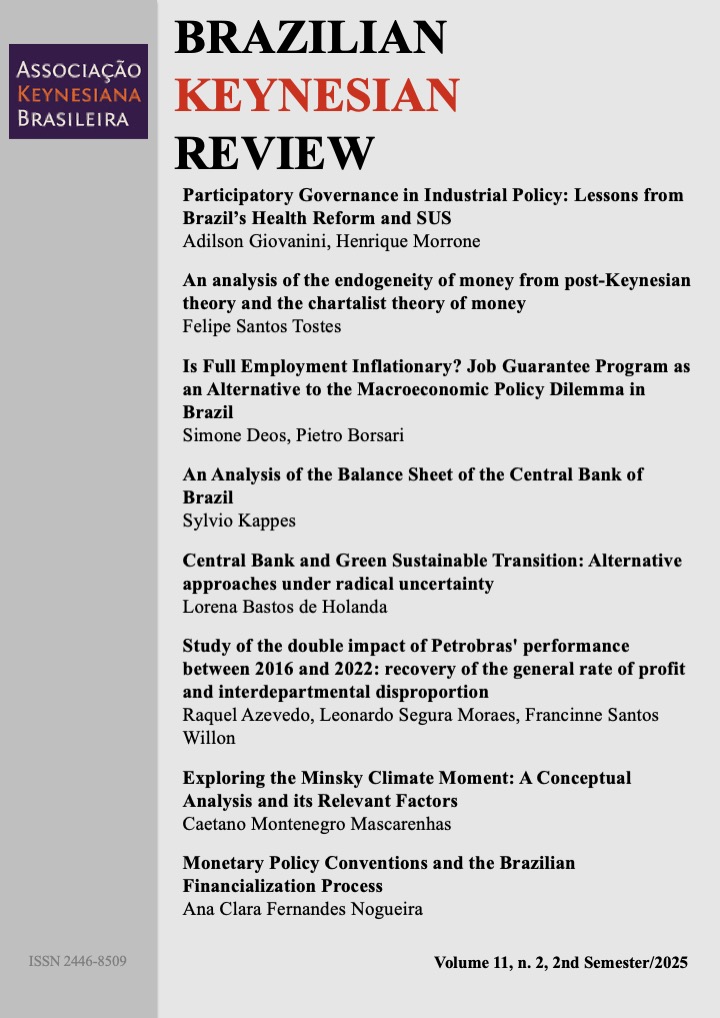
An analysis of the endogeneity of money from post-Keynesian theory and the chartalist theory of money
DOI:
https://doi.org/10.33834/bkr.v11i2.368Keywords:
Monetary Theory, Post-Keynesian Theory, ChartalismAbstract
This paper analyzed the endogeny of the money supply. The discussion about the origin of the money supply was introduced as a starting point. A first conclusion is that Keynes and post-Keynesians agree with chartalist theory of money, but disagree the hypothesis of full endogeny of the money. For them, the money will be endogeny only with development of banks. This paper has the main hypothesis the full endogeny of the money supply. In this case, not to be need development of banks for currency to be created, because the primary relationship through debit already put the money essentially as endogenous.
Downloads
References
Barro, R. J.; Gordon, D. B. (1983). Rules, discretion and reputation in a model of monetary policy. Journal of monetary economics, 12(1), p.101-121. DOI: 10.1016/0304-3932(83)90051-X
Carvalho, F. C. de. (1993). Sobre a endogenia da oferta de moeda: réplica ao professor Nogueira da Costa. Brazilian Journal of Political Economy, 13(3), p.454-462. DOI: 10.1590/0101-31571993-0679
Carvalho, F. C. de. et al. (2007). Economia Monetária e Financeira: teoria e política. Rio de Janeiro: Campus.
Chick, V. (1992). The evolution of the banking system and the theory of saving, investment and interest. Palgrave Macmillan UK, 1992. In: CHICK, V.; ARESTIS, P.; DOW, S. C. On money, method and Keynes: selected essays. New York: St. Martin's Press. DOI: 10.1007/978-1-349-21935-3_12
Fernandes, A. L. C. e Mota, P. R. T. (2013). A Teoria da Política Monetária na Actualidade. Ed. Almedina.
Fiocca, D. (2000). A oferta de moeda na macroeconomia keynesiana. Paz e Terra.
Graeber, D. (2016). Dívida: Os primeiros 5000 anos. Três Estrelas.
Innes, A. M. (2004). What is Money? Edward Elgar Publishing. In: WRAY, L. Randall (Ed.). Credit and state theories of money: the contributions of A. Mitchell Innes. DOI: 10.4337/9781843769842.00007.
Knapp, G. F. (1924). The state theory of money. DOI: 10.1086/253772.
Keynes, J. M. (1930). A treatise on money. Harcourt, Brace and company. DOI: 10.1177/000271623115400143.
Minsky, H. P. (1991). The endogeneity of money. In: NELL, Edward J.; SEMMLER, Willi. Nicholas Kaldor and mainstream economics: confrontation or convergence? Springer. DOI: 10.1007/978-1-349-10947-0_11.
Minsky, H. P. (2009). Estabilizando uma economia instável. Novo Século editora.
Modenesi, A. M. (2005). Regimes monetários: teoria e a experiência do real. Editora Manole Ltda.
Mollo, M. L. R. (1994). As controvérsias monetárias do século XIX. Ensaios FEE, 15(1), p. 80-97.
Moore, B. J. (1988). Horizontalists and verticalists: the macroeconomics of credit money. Cambridge University Press. DOI: 10.2307/2234160.
Nayan, S. et al. (2013). Post Keynesian endogeneity of money supply: Panel evidence. Procedia Economics and Finance, 7, p. 48-54. DOI: 10.1016/s2212-5671(13)00217-7
Palley, T. (2008). Endogenous money: implications for the money supply process, interest rates, and macroeconomics. PERI working papers n.178. DOI: 10.7275/1282937
Paula, L. F. (2014). Sistema Financeiro, bancos e financiamento da economia. Elsevier.
Rochon, L. (2001). Cambridge's Contribution to Endogenous Money: Robinson and Kahn on credit and money. Review of Political Economy, 13(3), p. 287-307. DOI: 10.1080/09538250120055159.
Rochon, L.; Rossi, S. (2013). Endogenous money: the evolutionary versus revolutionary views. Review of Keynesian Economics, 1(2), p.210-229. DOI: 10.4337/roke.2013.02.04.
Salomão, I. C. (2025). O Debate Monetário no Brasil do Século XIX. Informações FIPE, 532, p. 71-74.
Smith, A. (1776 [1988]). A riqueza das nações. Nova Cultural.
Terra, F. H. B. (2014). Uma interpretação pós-keynesiana do Regime de Metas de Inflação: poderia a Autoridade Monetária ser capturada pelo sistema bancário? Revista da Sociedade Brasileira de Economia Política, 38, p.108-127.
Usher, A. P. (1934). The origins of banking: The primitive bank of deposit, 1200–1600. The Economic History Review, 4(4), p.399-428. DOI: 10.1111/j.1468-0289.1934.tb02264.x.
Wray, L. R. (2000). The neo-chartalist approach to money. Available at SSRN 1010334. DOI: 10.2139/ssrn.1010334.
Wray, L. R. (2007). Endogenous money: Structuralist and horizontalist.
Wray, L. R. (2012). Introduction to an alternative history of money. Levy Economics Institute, working paper, (717). DOI: 10.2139/ssrn.2050427.
Zelmanovitz, L. (2012). Breve relato da história das ideias sobre moeda a partir de Aristóteles. Philia&Filia, 3(2), p.61-83.
Downloads
Published
How to Cite
Issue
Section
License
- Authors keep copyrights and concede to the Journal the right to the first publication, with the paper simultaneously licenced under the Creative Commons Attribution 4.0 International License which allows recognised author and journal work sharing.
- Authors are authorized to assume additional contracts separately, for non-exclusive versions of the paper published in this journal (e.g.: publish in an instituional repository or as a book chapter) with the recogntion of authorship and initial publication in this journal.
- Authors are allowed (and are estimulated) to publish and distribute their work online (e.g.: in institutional repositories or at their personal websites) at any point before or during the editorial process, once this may generate productive alterations on the paper, as well as increse the factor of impact and quotation of the published paper (please, see Free Access Effect)