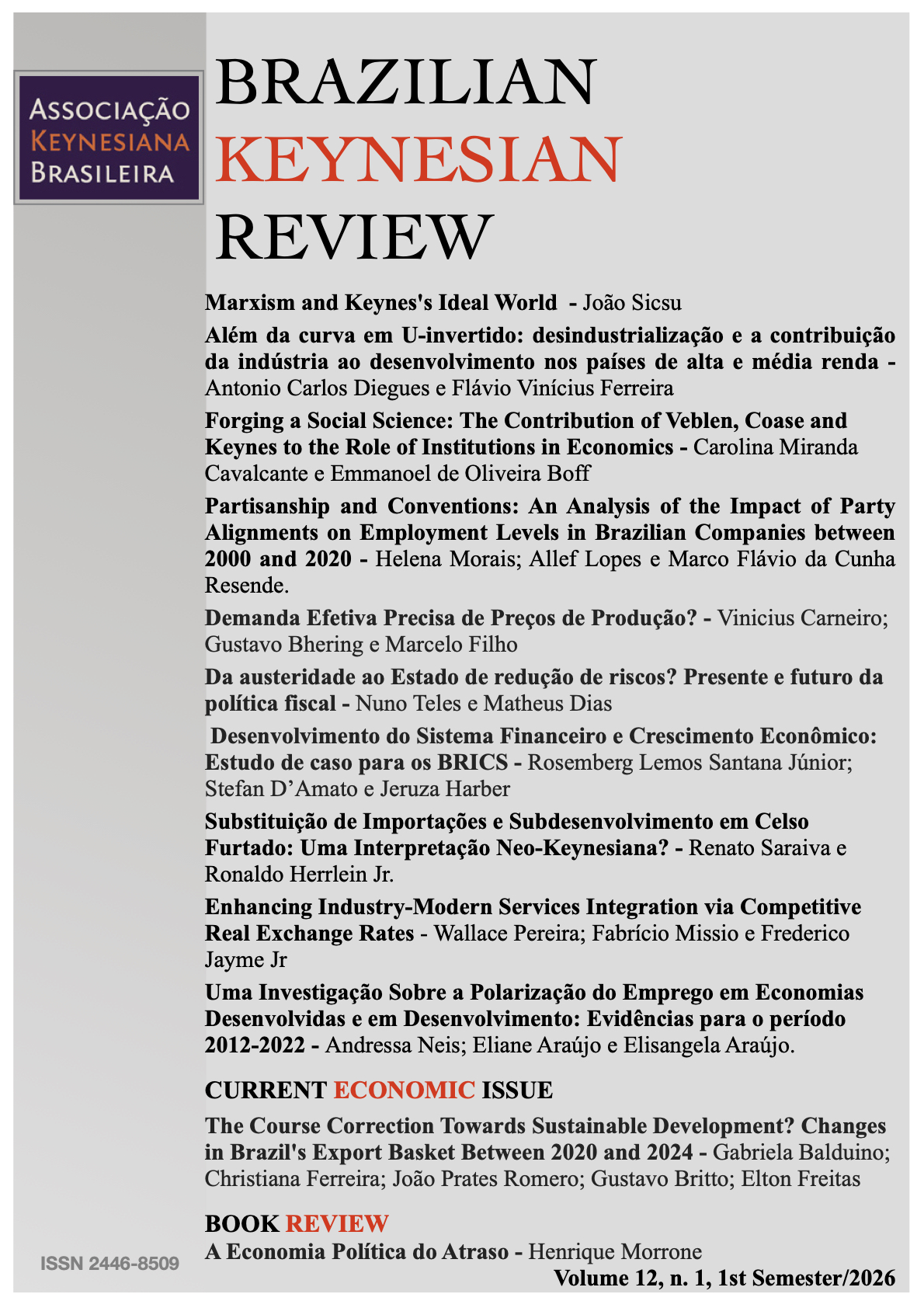
An Investigation into Employment Polarization in Developed and Developing Economies
Evidence for the Period 2012–2022
DOI:
https://doi.org/10.33834/bkr.v12i1.400Keywords:
Job polarization, Labor market, Digital economy, Panel dataAbstract
This paper theoretically and empirically investigates job polarization in a selected group of developed and developing economies from 2012 to 2022. The research analyzes the main factors influencing this phenomenon, including technological changes, globalization, offshoring, and structural change, represented by the share of the manufacturing industry in GDP. To this end, an econometric approach based on panel data is employed, allowing the identification of the determinants of labor market polarization. The results indicate that while technological advances, globalization, and offshoring have intensified polarization by increasing the demand for high- and low-skilled jobs to the detriment of medium-skilled ones, the share of the manufacturing industry in GDP has had the opposite effect, reducing this phenomenon. These findings underscore the importance of public policies aimed at workforce retraining and strengthening the industrial sector as a strategy to mitigate the negative impacts of job polarization.
Downloads
References
Acemoglu, D. (2002). Technical change, inequality, and the labor market. Journal of Economic Literature, 40(1), 7–72.
Acemoglu, D., & Autor, D. (2011). Skills, tasks and technologies: Implications for employment and earnings. In O. Ashenfelter & D. Card (Eds.), Handbook of labor economics (Vol. 4B, pp. 1043–1171). Elsevier. DOI:10.1016/S0169-7218(11)02410-5
Arellano, M., & Bond, S. (1991). Some tests of specification for panel data: Monte Carlo evidence and an application to employment equations. The Review of Economic Studies, 58(2), 277–297. DOI:10.2307/2297968
Arellano, M., & Bover, O. (1995). Another look at the instrumental variable estimation of error-components models. Journal of Econometrics, 68(1), 29–51. DOI: 10.1016/0304-4076(94)01642-D
Autor, D. H. (2015). Why are there still so many jobs? The history and future of workplace automation. Journal of Economic Perspectives, 29(3), 3–30. DOI:10.1257/jep.29.3.3
Autor, D. H., Dorn, D., & Hanson, G. H. (2016). The China shock: Learning from labor-market adjustment to large changes in trade. Annual Review of Economics, 8(1), 205–240. DOI:10.1146/annurev-economics-080315-015041
Autor, D. H., Levy, F., & Murnane, R. J. (2003). The skill content of recent technological change: An empirical exploration. The Quarterly Journal of Economics, 118(4), 1279–1333. DOI:10.1162/003355303322552801
Autor, D., Katz, L. F., & Kearney, M. S. (2006). The polarization of the U.S. labor market. American Economic Review, 96(2), 189–194. DOI:10.1257/000282806777212620
Blinder, A. S., & Krueger, A. B. (2009). Alternative measures of offshorability: A survey approach. NBER Working Paper Series (No. 15287).
Blundell, R., & Bond, S. (1998). Initial conditions and moment restrictions in dynamic panel data models. Journal of Econometrics, 87(1), 115–143. DOI:10.1016/S0304-4076(98)00009-8
Breemersch, K., Damijan, J. P., & Konings, J. (2019). What drives labor market polarisation in advanced countries? The role of China and technology. Industrial and Corporate Change, 28(1), 51–77. DOI: 10.1093/icc/dty063
Buera, F. J., Kaboski, J. P., Rogerson, R., & Vizcaino, B. (2022). Skill-biased structural change. Review of Economic Studies, 89(2), 592–625. DOI:10.1093/restud/rdab035
Card, D., & DiNardo, J. E. (2002). Skill-biased technological change and rising wage inequality: Some problems and puzzles. Journal of Labor Economics, 20(4), 733–783. DOI:10.1086/342055
Cazzaniga, M., Jaumotte, F., Li, L., Melina, G., Panton, A. J., Pizzinelli, C., Rockall, E., & Tavares, M. M. (2024). Gen-AI: Artificial intelligence and the future of work. IMF Staff Discussion Note No. 2024/001. DOI:10.5089/9798400262548.006
Fernández-Macías, E., & Hurley, J. (2016). Routine-biased technical change and job polarization in Europe. Socio-Economic Review, 15(3), 563–585.
Ferreira, P. (2022). Futuro do trabalho no Brasil: Mudanças de uma revolução acelerada. Fundação Getulio Vargas.
Freeman, C., & Soete, L. (2013). The economics of industrial innovation (3rd ed.). Routledge. (Obra original publicada em 1997). DOI:10.4324/9780203064474
Gala, P., Rocha, I., Magacho, G., & Morceiro, P. (2018). Sophisticated jobs matter for economic complexity: An empirical analysis based on input-output matrices and employment data. Structural Change and Economic Dynamics, 45, 1–8. DOI:10.1016/j.strueco.2017.11.005
Goos, M., & Manning, A. (2007). Lousy and lovely jobs: The rising polarization of work in Britain. The Review of Economics and Statistics, 89(1), 118–133.
Goos, M., Manning, A., & Salomons, A. (2009). Job polarization in Europe. American Economic Review, 99(2), 58–63. DOI:10.1257/aer.99.2.58
Goos, M., Manning, A., & Salomons, A. (2014). Explaining job polarization: Routine-biased technological change and offshoring. American Economic Review, 104(8), 2509–2526. DOI:10.1257/aer.104.8.2509
International Labour Organization. (2024). ILOSTAT.
Ketchen, D. J., & Shook, C. L. (1996). The application of cluster analysis in strategic management research: An analysis and critique. Strategic Management Journal, 17(6), 441–458. DOI:10.1002/(SICI)1097-0266(199606)17:6<441::AID-SMJ819>3.0.CO;2-G
McMillan, M., Rodrik, D., & Verduzco-Gallo, Í. (2014). Globalization, structural change, and productivity growth, with an update on Africa. World Development, 63, 11–32. DOI:10.1016/j.worlddev.2013.10.012
Molina, C., & Maloney, W. F. (2019). Why formal jobs are good for workers. World Bank.
Perez, C. (2002). Technological revolutions and financial capital: The dynamics of bubbles and golden ages. Edward Elgar Publishing. DOI:10.4337/9781781005323
Roodman, D. (2009). A note on the theme of too many instruments. Oxford Bulletin of Economics and Statistics, 71(1), 135–158. DOI:10.1111/j.1468-0084.2008.00542.x
Spitz-Oener, A. (2006). Technical change, job tasks, and rising educational demands: Looking outside the wage structure. Journal of Labor Economics, 24(2), 235–270. DOI:10.1086/499972
Szirmai, A. (2012). Industrialisation as an engine of growth in developing countries, 1950–2005. Structural Change and Economic Dynamics, 23(4), 406–420. DOI:10.1016/j.strueco.2011.01.005
Tuzemen, D., & Willis, J. (2013). The vanishing middle: Job polarization and workers’ response to the decline in middle-skill jobs. Economic Review, 98(Q1), 5–32.
World Economic Forum. (2023). The future of jobs report 2023. World Economic Forum.
Downloads
Published
How to Cite
Issue
Section
License
Copyright (c) 2026 Andressa Neis, Eliane Araújo, Elisangela Araújo

This work is licensed under a Creative Commons Attribution 4.0 International License.
- Authors keep copyrights and concede to the Journal the right to the first publication, with the paper simultaneously licenced under the Creative Commons Attribution 4.0 International License which allows recognised author and journal work sharing.
- Authors are authorized to assume additional contracts separately, for non-exclusive versions of the paper published in this journal (e.g.: publish in an instituional repository or as a book chapter) with the recogntion of authorship and initial publication in this journal.
- Authors are allowed (and are estimulated) to publish and distribute their work online (e.g.: in institutional repositories or at their personal websites) at any point before or during the editorial process, once this may generate productive alterations on the paper, as well as increse the factor of impact and quotation of the published paper (please, see Free Access Effect)