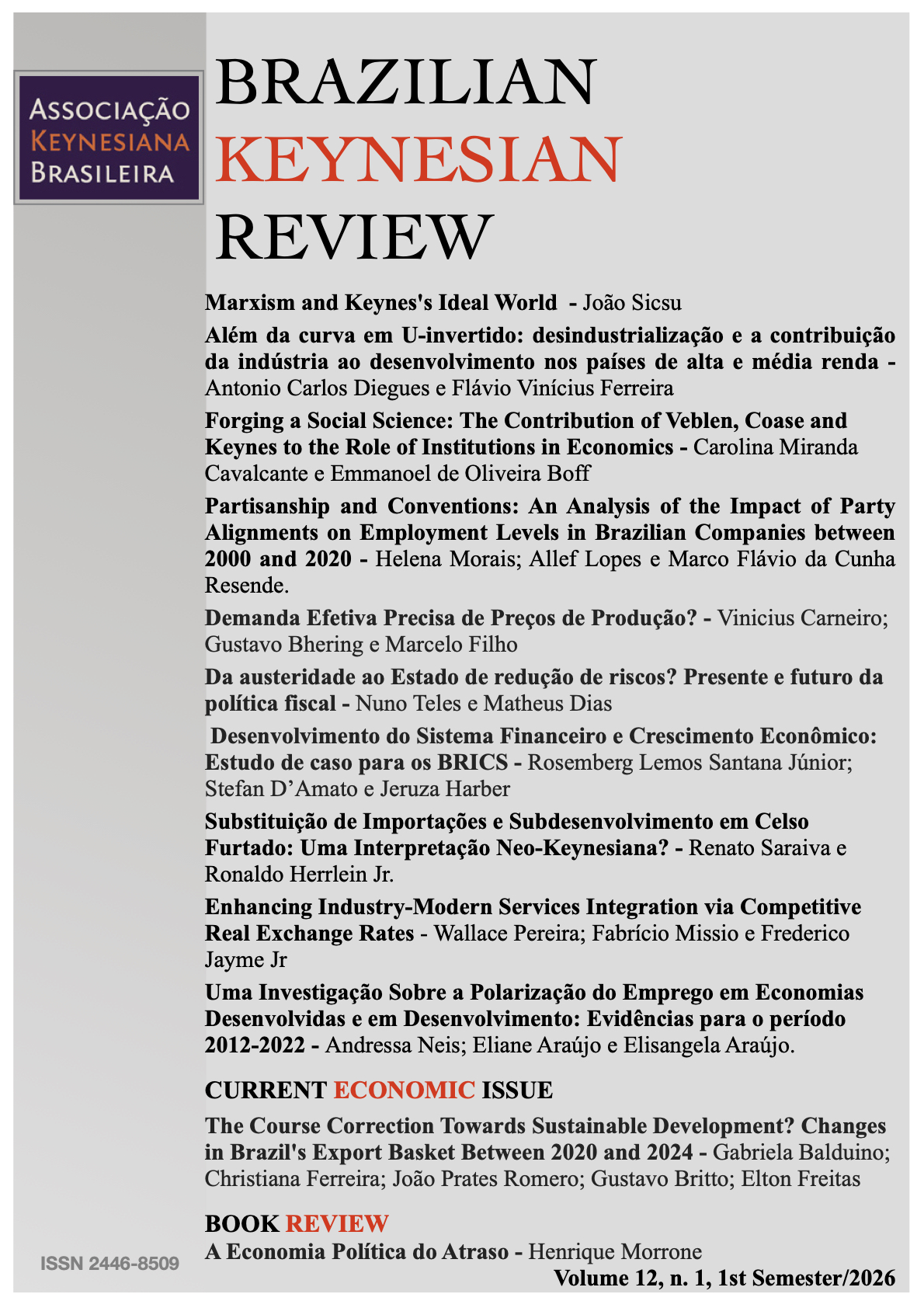
Uma Uma Investigação Sobre a Polarização do Emprego em Economias Desenvolvidas e em Desenvolvimento
Evidências para o período 2012-2022
DOI:
https://doi.org/10.33834/bkr.v12i1.400Palavras-chave:
polarização, mercado de trabalho, economia digital, modelo de dados em painelResumo
Este artigo investiga teórica e empiricamente a polarização do emprego em um grupo de economias desenvolvidas e em desenvolvimento no período de 2012 a 2022. A pesquisa analisa os principais fatores que influenciam esse fenômeno, incluindo mudanças tecnológicas, globalização, deslocamento de empregos para outros países (offshoring) e a mudança estrutural, representada pela participação da indústria manufatureira no PIB. Para isso, é utilizada uma abordagem econométrica baseada em dados em painel, de modo a se identificar os determinantes da polarização do emprego. Os resultados indicaram que, enquanto o avanço tecnológico, a globalização e o offshoring intensificaram a polarização ao ampliar a demanda por empregos de alta e baixa qualificação, em detrimento dos de qualificação intermediária; a participação da indústria manufatureira no PIB apresentou um efeito inverso, reduzindo esse fenômeno. Esses achados reforçam a importância de políticas públicas voltadas à requalificação da força de trabalho e ao fortalecimento do setor industrial como estratégia para mitigar os impactos negativos da polarização do emprego.
Downloads
Referências
Acemoglu, D. (2002). Technical change, inequality, and the labor market. Journal of Economic Literature, 40(1), 7–72.
Acemoglu, D., & Autor, D. (2011). Skills, tasks and technologies: Implications for employment and earnings. In O. Ashenfelter & D. Card (Eds.), Handbook of labor economics (Vol. 4B, pp. 1043–1171). Elsevier. DOI:10.1016/S0169-7218(11)02410-5
Arellano, M., & Bond, S. (1991). Some tests of specification for panel data: Monte Carlo evidence and an application to employment equations. The Review of Economic Studies, 58(2), 277–297. DOI:10.2307/2297968
Arellano, M., & Bover, O. (1995). Another look at the instrumental variable estimation of error-components models. Journal of Econometrics, 68(1), 29–51. DOI: 10.1016/0304-4076(94)01642-D
Autor, D. H. (2015). Why are there still so many jobs? The history and future of workplace automation. Journal of Economic Perspectives, 29(3), 3–30. DOI:10.1257/jep.29.3.3
Autor, D. H., Dorn, D., & Hanson, G. H. (2016). The China shock: Learning from labor-market adjustment to large changes in trade. Annual Review of Economics, 8(1), 205–240. DOI:10.1146/annurev-economics-080315-015041
Autor, D. H., Levy, F., & Murnane, R. J. (2003). The skill content of recent technological change: An empirical exploration. The Quarterly Journal of Economics, 118(4), 1279–1333. DOI:10.1162/003355303322552801
Autor, D., Katz, L. F., & Kearney, M. S. (2006). The polarization of the U.S. labor market. American Economic Review, 96(2), 189–194. DOI:10.1257/000282806777212620
Blinder, A. S., & Krueger, A. B. (2009). Alternative measures of offshorability: A survey approach. NBER Working Paper Series (No. 15287).
Blundell, R., & Bond, S. (1998). Initial conditions and moment restrictions in dynamic panel data models. Journal of Econometrics, 87(1), 115–143. DOI:10.1016/S0304-4076(98)00009-8
Breemersch, K., Damijan, J. P., & Konings, J. (2019). What drives labor market polarisation in advanced countries? The role of China and technology. Industrial and Corporate Change, 28(1), 51–77. DOI: 10.1093/icc/dty063
Buera, F. J., Kaboski, J. P., Rogerson, R., & Vizcaino, B. (2022). Skill-biased structural change. Review of Economic Studies, 89(2), 592–625. DOI:10.1093/restud/rdab035
Card, D., & DiNardo, J. E. (2002). Skill-biased technological change and rising wage inequality: Some problems and puzzles. Journal of Labor Economics, 20(4), 733–783. DOI:10.1086/342055
Cazzaniga, M., Jaumotte, F., Li, L., Melina, G., Panton, A. J., Pizzinelli, C., Rockall, E., & Tavares, M. M. (2024). Gen-AI: Artificial intelligence and the future of work. IMF Staff Discussion Note No. 2024/001. DOI:10.5089/9798400262548.006
Fernández-Macías, E., & Hurley, J. (2016). Routine-biased technical change and job polarization in Europe. Socio-Economic Review, 15(3), 563–585.
Ferreira, P. (2022). Futuro do trabalho no Brasil: Mudanças de uma revolução acelerada. Fundação Getulio Vargas.
Freeman, C., & Soete, L. (2013). The economics of industrial innovation (3rd ed.). Routledge. (Obra original publicada em 1997). DOI:10.4324/9780203064474
Gala, P., Rocha, I., Magacho, G., & Morceiro, P. (2018). Sophisticated jobs matter for economic complexity: An empirical analysis based on input-output matrices and employment data. Structural Change and Economic Dynamics, 45, 1–8. DOI:10.1016/j.strueco.2017.11.005
Goos, M., & Manning, A. (2007). Lousy and lovely jobs: The rising polarization of work in Britain. The Review of Economics and Statistics, 89(1), 118–133.
Goos, M., Manning, A., & Salomons, A. (2009). Job polarization in Europe. American Economic Review, 99(2), 58–63. DOI:10.1257/aer.99.2.58
Goos, M., Manning, A., & Salomons, A. (2014). Explaining job polarization: Routine-biased technological change and offshoring. American Economic Review, 104(8), 2509–2526. DOI:10.1257/aer.104.8.2509
International Labour Organization. (2024). ILOSTAT.
Ketchen, D. J., & Shook, C. L. (1996). The application of cluster analysis in strategic management research: An analysis and critique. Strategic Management Journal, 17(6), 441–458. DOI:10.1002/(SICI)1097-0266(199606)17:6<441::AID-SMJ819>3.0.CO;2-G
McMillan, M., Rodrik, D., & Verduzco-Gallo, Í. (2014). Globalization, structural change, and productivity growth, with an update on Africa. World Development, 63, 11–32. DOI:10.1016/j.worlddev.2013.10.012
Molina, C., & Maloney, W. F. (2019). Why formal jobs are good for workers. World Bank.
Perez, C. (2002). Technological revolutions and financial capital: The dynamics of bubbles and golden ages. Edward Elgar Publishing. DOI:10.4337/9781781005323
Roodman, D. (2009). A note on the theme of too many instruments. Oxford Bulletin of Economics and Statistics, 71(1), 135–158. DOI:10.1111/j.1468-0084.2008.00542.x
Spitz-Oener, A. (2006). Technical change, job tasks, and rising educational demands: Looking outside the wage structure. Journal of Labor Economics, 24(2), 235–270. DOI:10.1086/499972
Szirmai, A. (2012). Industrialisation as an engine of growth in developing countries, 1950–2005. Structural Change and Economic Dynamics, 23(4), 406–420. DOI:10.1016/j.strueco.2011.01.005
Tuzemen, D., & Willis, J. (2013). The vanishing middle: Job polarization and workers’ response to the decline in middle-skill jobs. Economic Review, 98(Q1), 5–32.
World Economic Forum. (2023). The future of jobs report 2023. World Economic Forum.
Downloads
Publicado
Como Citar
Edição
Seção
Licença
Copyright (c) 2026 Andressa Neis, Eliane Araújo, Elisangela Araújo

Este trabalho está licenciado sob uma licença Creative Commons Attribution 4.0 International License.
- Autores mantém os direitos autorais e concedem à revista o direito de primeira publicação, com o trabalho simultaneamente licenciado sob a Licença Creative Commons Attribution que permite o compartilhamento do trabalho com reconhecimento da autoria e publicação inicial nesta revista.
- Autores têm autorização para assumir contratos adicionais separadamente, para distribuição não-exclusiva da versão do trabalho publicada nesta revista (ex.: publicar em repositório institucional ou como capítulo de livro), com reconhecimento de autoria e publicação inicial nesta revista.
- Autores têm permissão e são estimulados a publicar e distribuir seu trabalho online (ex.: em repositórios institucionais ou na sua página pessoal) a qualquer ponto antes ou durante o processo editorial, já que isso pode gerar alterações produtivas, bem como aumentar o impacto e a citação do trabalho publicado (Veja O Efeito do Acesso Livre).