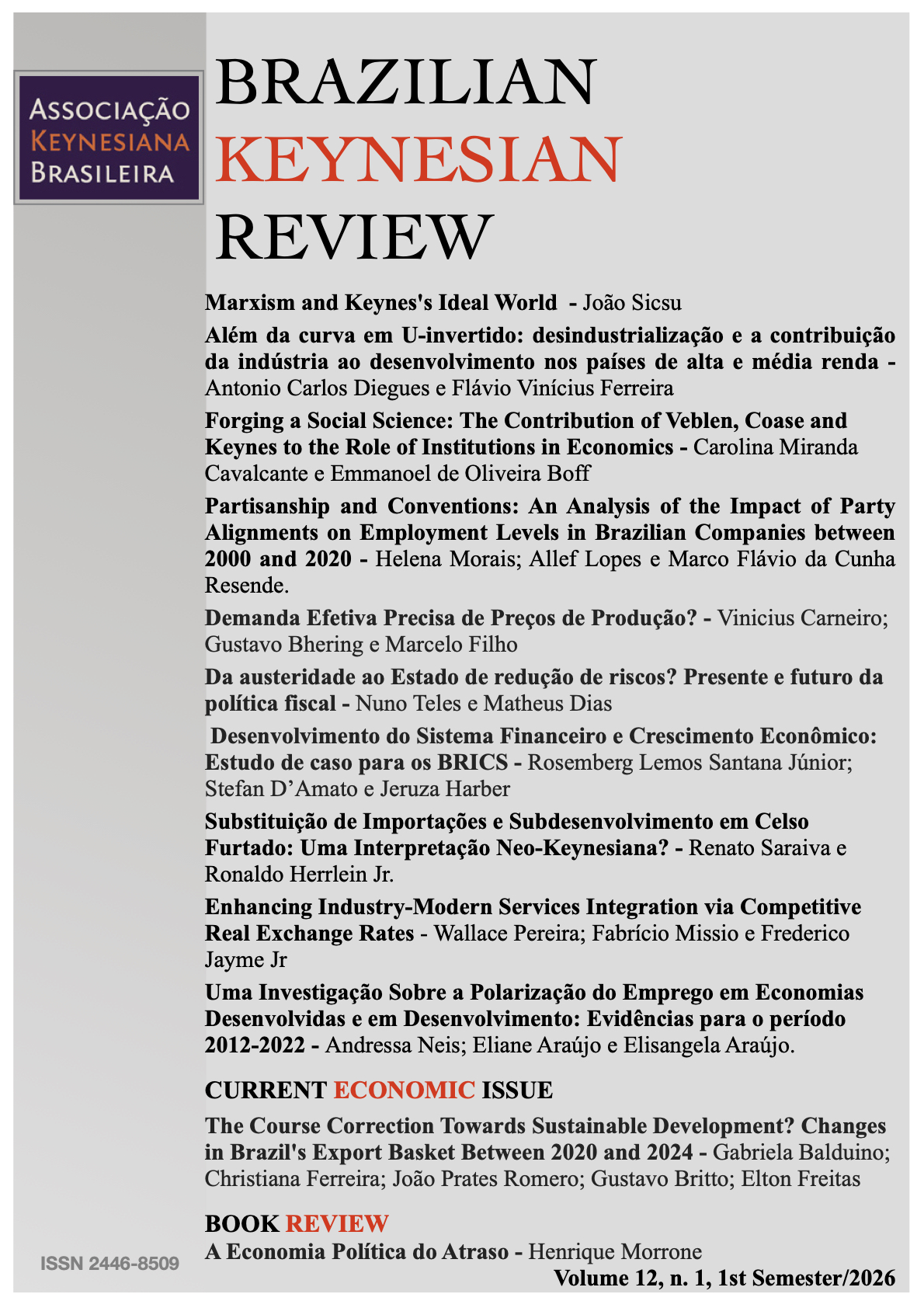
Demanda Efetiva Precisa de Preços de Produção?
DOI:
https://doi.org/10.33834/bkr.v12i1.394Keywords:
Effective Demand, Production Prices, Principle of Effective DemandAbstract
Every economic theory requires an explicit relationship between distribution and its theory production. In fact, the concept of effective demand has been explored by all authors since the classical authors of Political Economy. This concept can only be defined from some definition of supply price, as it is the price that ensures profitable production of goods. Thus, effective demand is the monetary demand that pays the production prices. We contrast the marginalist approach with the surplus approach, highlighting the criticisms made by Sraffa. Therefore, we seek to analyze the theories addressed and point out how they relate the determination of relative prices to production. We conclude that the surplus approach is the only one compatible with different production theories, given the logical inconsistencies of marginalist theory, and the union between classical production prices and the Principle of Effective Demand is essential to overcome the inconsistencies of neoclassical approaches and Say's Law.
Downloads
References
Allain, O. (2015). Tackling the instability of growth: A Harrodian model with an autonomous expenditure component. Cambridge Journal of Economics, 39(5), 1351–1371.
Bhering, G. (2017). Princípio de Say, distribuição internacional do ouro e demandas efetivas recíprocas (Tese de doutorado). Universidade Federal do Rio de Janeiro.
Eatwell, J., & Milgate, M. (2011). The fall and rise of Keynesian economics. Oxford University Press.
Freitas, F., & Serrano, F. (2015). Growth rate and level effects, the stability of the adjustment of capacity to demand, and the Sraffian supermultiplier. Review of Political Economy, 27(3), 258–281.
Garegnani, P. (2015). The problem of effective demand in Italian economic development: On the factors that determine the volume of investment. Review of Political Economy, 27(2), 111–133. (Trabalho original publicado em 1962)
Garegnani, P. (1978). Notes on consumption, investment and effective demand. In J. Eatwell & M. Milgate (Eds.), Keynes’s economics and the theory of value and distribution (pp. xx–xx). Oxford University Press.
Garegnani, P. (1983). Two routes to effective demand: Comment on Kregel. In J. A. Kregel (Ed.), Distribution, effective demand and international economic relations (pp. xx–xx). Macmillan.
Garegnani, P. (1984). Value and distribution in the classical economists and Marx. Oxford Economic Papers, 36(2), 291–325.
Garegnani, P. (1987). Surplus approach to value and distribution. In J. Eatwell, M. Milgate, & P. Newman (Eds.), The New Palgrave: A dictionary of economics (Vol. 4, pp. xx–xx). Macmillan.
Kalecki, M. (1971). Selected essays on the dynamics of the capitalist economy: 1930–1970. Cambridge University Press.
Kalecki, M. (1980). As equações marxistas da reprodução e a economia moderna. In J. Miglioli (Org. & Trad.), Crescimento e ciclo das economias capitalistas (2. ed.). Hucitec. (Trabalho original publicado em 1977)
Keynes, J. M. (1996). A teoria geral do emprego, do juro e da moeda. Nova Cultural. (Trabalho original publicado em 1936)
Lavoie, M. (2022). Post-Keynesian economics: New foundations (2nd ed.). Edward Elgar.
Lazzarini, A. (2011). Revisiting the Cambridge capital theory controversies: A historical and analytical study. Pavia University Press.
Matthews, R. C. O. (1964). O ciclo econômico. Zahar. (Trabalho original publicado em 1959)
Moreira, V. G., & Serrano, F. (2019). O debate envolvendo o efeito acelerador na controvérsia sobre o modelo do supermultiplicador sraffiano. Revista de Economia Contemporânea, 23(3).
Ricardo, D. (1951). On the principles of political economy and taxation. In P. Sraffa & M. H. Dobb (Eds.), The works and correspondence of David Ricardo. Cambridge University Press. (Trabalho original publicado em 1821)
Serrano, F. (1995). The Sraffian supermultiplier (Tese de doutorado não publicada). University of Cambridge.
Serrano, F. (2003). Estabilidade nas abordagens clássica e neoclássica. Economia e Sociedade, 12(2), 147–167.
Serrano, F. (2004). Notas sobre o ciclo e a tendência e o supermultiplicador (Mimeo). Instituto de Economia, Universidade Federal do Rio de Janeiro.
Serrano, F., Freitas, F., & Bhering, G. (2020). O supermultiplicador sraffiano, a instabilidade fundamental de Harrod e o dilema de “Oxbridge”. Análise Econômica, 38(77), 27–54.
Sraffa, P. (1960). Production of commodities by means of commodities: Prelude to a critique of economic theory. Cambridge University Press.
Downloads
Published
How to Cite
Issue
Section
License
Copyright (c) 2026 Vinicius Carneiro, Gustavo, Marcelo

This work is licensed under a Creative Commons Attribution 4.0 International License.
- Authors keep copyrights and concede to the Journal the right to the first publication, with the paper simultaneously licenced under the Creative Commons Attribution 4.0 International License which allows recognised author and journal work sharing.
- Authors are authorized to assume additional contracts separately, for non-exclusive versions of the paper published in this journal (e.g.: publish in an instituional repository or as a book chapter) with the recogntion of authorship and initial publication in this journal.
- Authors are allowed (and are estimulated) to publish and distribute their work online (e.g.: in institutional repositories or at their personal websites) at any point before or during the editorial process, once this may generate productive alterations on the paper, as well as increse the factor of impact and quotation of the published paper (please, see Free Access Effect)