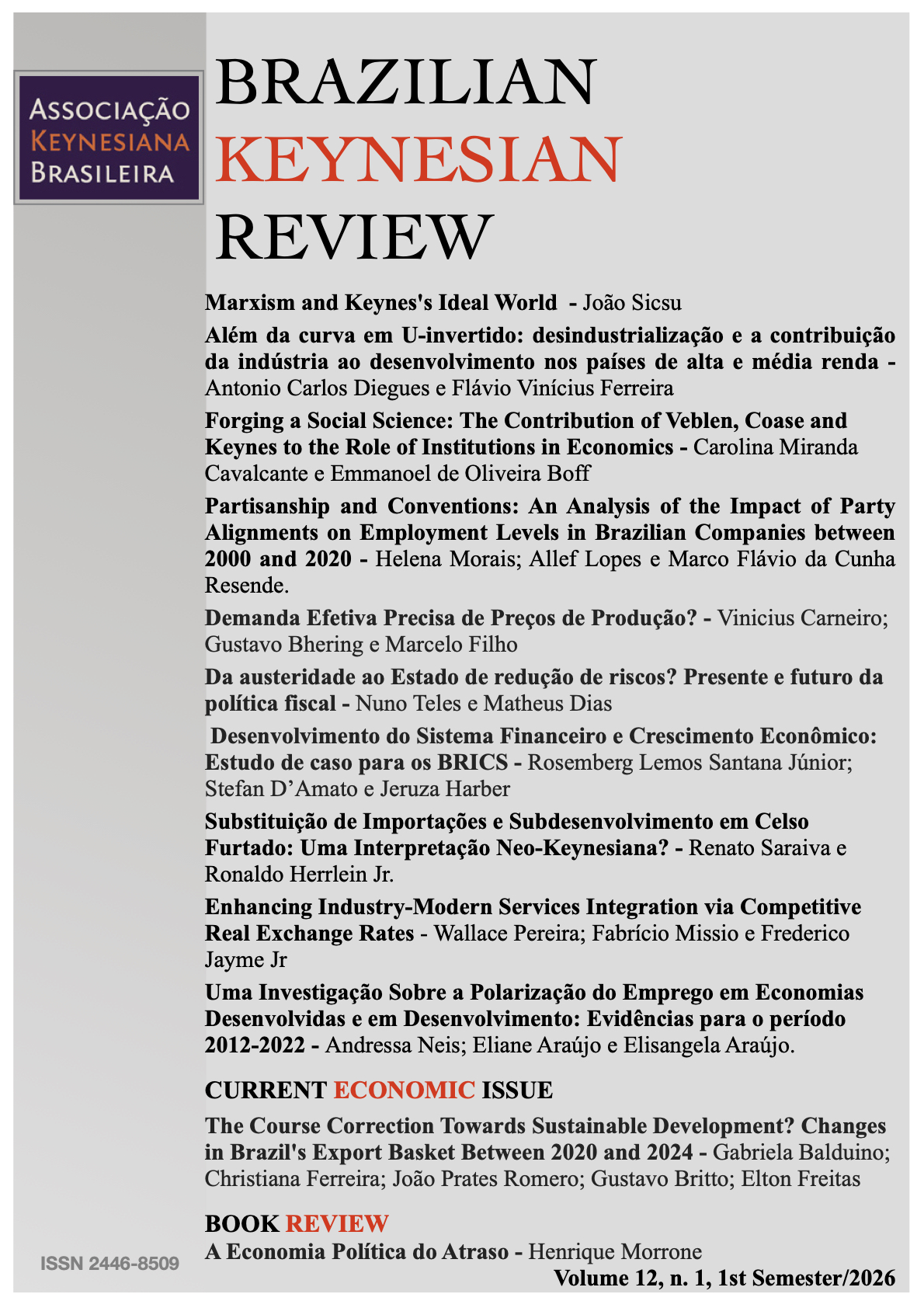
From austerity to the risk management state?
Present and Future of the fiscal policy
DOI:
https://doi.org/10.33834/bkr.v12i1.390Palavras-chave:
Política Fiscal, Austeridade, Estado de redução de riscos, Novo Consenso Macroeconômico, Parceria Público-PrivadaResumo
As últimas três décadas testemunharam a crescente imposição de regras fiscais que visam a redução do gasto público e limites à intervenção pública na economia. Estes dispositivos políticos têm o seu suporte teórico no “Novo Consenso Macroeconômico”, síntese das contribuições monetarista, novo clássico e novo-keynesiano. Estabelecida a política fiscal restritiva permanente, o investimento público foi substituído por novos modelos de financiamento privado, sobretudo na forma de Parcerias Público-Privada (PPP). O recente ressurgimento da política industrial e o aumento dos déficits orçamentários são frequentemente entendidos como o fim da austeridade. Este artigo argumenta que não é esse o caso. Partindo da comparação das trajetórias na política fiscal entre a UE, pioneira das regras fiscais, e o Brasil, onde estas regras foram mais restritivas, argumenta-se que assistimos hoje a um novo modelo de austeridade fiscal, seletiva, disposta ao gasto em setores considerados estratégicos, da energia à defesa. O Estado reforça o seu papel na redução de riscos ao capital privado, seja na forma de subsídios e garantias financeiras, no caso europeu, ou em formas mais robustas, através de uma nova aposta nas Parcerias Público-Privadas, no caso do Brasil. Embora com contradições, a política fiscal neoliberal se reinventa e perdura.
Downloads
Referências
ALBEROLA, E. et al. (2021) “Fiscal response to the COVID‐19 crisis in advanced and emerging market economies”, Pacific Economic Review, 26(4), p. 459-468. DOI: https://doi.org/10.1111/1468-0106.12370
ARESTIS, P.; SAWYER, M. C. (2003) “New Consensus New Keynesianism, and the Economics of the Third Way”, Levy Economics Institute Working Paper No. 364. Disponível em: https://www.levyinstitute.org/pubs/wp_364.pdf
BAHIA. (2023) “Novo PAC do Governo Federal vai investir R$ 119,4 bilhões em obras na Bahia; governador participou do lançamento”, Disponível em: <https://www.ba.gov.br/casacivil/noticia/2024-05/2091/novo-pac-do-governo-federal-vai-investir-r-1194-bilhoes-em-obras-na-bahia>. Acesso em: 19 jun. 2024.
BILBIIE, F.; MONACELLI, T.; PEROTTI, R. (2021) “Fiscal Policy in Europe: Controversies over Rules, Mutual Insurance, and Centralization”, Journal of Economic Perspectives, 35(2), p. 77–100. DOI: 10.1257/jep.35.2.77
BLANCHARD, O. J.; SUMMERS, L. H. (1986) “Hysteresis and the European Unemployment Problem”, In: Fischer, S. (Eds NBER Macroeconomics Annual 1986. Boston: MIT Press.
BRASIL. (2023) “Tesouro anuncia quatro medidas de incentivo a Parcerias Público-Privadas (PPP),”Disponível em: <https://www.gov.br/tesouronacional/pt-br/noticias/tesouro-anuncia-quatro-medidas-de-incentivo-a-parcerias-publico-privadas-ppp>. Acesso em: 3 de novembro de 2024
BUCHANAN, J. (1984) “Politics without Romance: A Sketch of Positive Public Choice Theory and its Normative Implications”, In: BUCHANAN, J.; TOLLISON, R. (Eds.). The Theory of Public Choice - II. Ann Arbor: University of Michigan Press.
BUDINA, N. et al. (2012) “Fiscal Rules at a Glance: Country Details from a New Dataset”. IMF Working Papers, 12(273) p. 1. Disponível em: <https://www.imf.org/external/pubs/ft/wp/2012/wp12273.pdf> Acesso em: 5 de outubro de 2024
CHrISTOPHERS, B. (2023) Our Lives in Their Portfolios. London: Verso Books.
COOPER, M. (2024) Counterrevolution: Extravagance and Austerity in Public Finance. New York: Zone Books.
THE INFRASCOPE (2022) “The 2021/2022 Infrascope: Country Summaries”. Disponível em: <https://impact.economist.com/projects/infrascope/evaluating-the-environment-for-public-private-partnerships-in-latin-america-and-the-caribbean/>. Acesso em: 20 de junho de 2024.
EUROPEAN COMMISSION (2024) “Recovery and Resilience Facility” Disponível em: <https://commission.europa.eu/business-economy-euro/economic-recovery/recovery-and-resilience-facility_en >. Acesso em: 11 junho de 2024.
EYRAUD, L, XAVIER, D, HODGE, A., LLEDÓ, V. E PATTILLO, C. (2018) “Second-Generation Fiscal Rules: Balancing Simplicity, Flexibility, and Enforceability”, Staff Discussion Notes, 18(04), p. 1. Disponível em: <https://www.imf.org/external/datamapper/fiscalrules/sdn1804-on-second-generation-fiscal-rules.pdf> Acesso em: 5 de outubro de 2024
FINE, B.; DIMAKOU. (2016) Macroeconomics: a critical companion. London: Pluto Press.
FRIEDMAN, M. e HELLER, W. W. (1969) Monetary vs. fiscal policy. New York: W. W. Norton.
FRIEDMAN, M. (1989). “Quantity Theory of Money”. In: Eatwell, J., Milgate, M., Newman, P. (eds) Money (The New Palgrave). London: Palgrave Macmillan DOI: https://doi.org/10.1007/978-1-349-19804-7_1
GABOR, D. (2023), “The (European) Derisking State”. SocArXiv Papers. DOI:10.31235/osf.io/hpbj2
GABOR, D. (2021) “The Wall Street Consensus”, Development and Change, 52(3), p. 429–459. DOI: https://doi.org/10.1111/dech.12645
GABOR, D. e SYLLA N. S. (2023) “Derisking Developmentalism: A Tale of Green Hydrogen”, Development and Change, 54(5), p. 1169-1196. DOI: https://doi.org/10.1111/dech.12779
GOBETTI, S. (2023) “Ajuste fiscal e os limites do possível, novamente”, FGV IBRE. Disponível em: <https://blogdoibre.fgv.br/posts/ajuste-fiscal-e-os-limites-do-possivel-novamente>. Acesso em: 21 de julho de 2024
TOOZE, A. (2019) Crashed: how a decade of financial crises changed the world. New York: Penguin Books.
KEDWARD, K.; GABOR, D.; RYAN-COLLINS, J. (2022) “Aligning finance with the green transition: From a risk-based to an allocative green credit policy regime”. UCL Institute for Innovation and Public Purpose, Working Paper Series 2022/11. DOI: https://dx.doi.org/10.2139/ssrn.4198146
KYDLAND, F. E. e PRESCOTT, E. C. (1977) “Rules Rather than Discretion: The Inconsistency of Optimal Plans”, Journal of Political Economy, 85(3), p. 473–491. Disponível em: <https://www.jstor.org/stable/1830193> . Acesso em: 5 de outubro de 2024
LAVOIE, M. (2015) Post-Keynesian Economics: New Foundations. Cheltenham: Edward Elgar Publishing.
LOPREATO, F. L. C. (2013) “Milton Friedman e a efetividade da política fiscal”, Revista de Economia Contemporânea, 17(2), p. 201–220. DOI: https://doi.org/10.1590/S1415-98482013000200001
LOPREATO, F. (2022) “Regras fiscais: o olhar internacional e a experiência brasileira”, Texto para Discussão n. 426. Disponível em: <https://www.eco.unicamp.br/images/arquivos/artigos/TD/TD426.pdf> Acesso em: 5 de outubro de 2024
LUCAS JR., R. E. e SARGENT, T. J. (1979) “After Keynesian Macroeconomics”, Quarterly Review, v. 3(2).
LUCAS, R. E. (1972) “Expectations and the neutrality of money”. Journal of Economic Theory, v. 4(2), p. 103–124. DOI: https://doi.org/10.1016/0022-0531(72)90142-1
MASTERS , B. e GARA, A. (2014) “BlackRock to buy Global Infrastructure Partners for $12.5bn” Disponível em: <https://www.ft.com/content/a0901489-6caa-42b8-ac55-1a09e64ef927>. Acesso em: 11 de junho de 2024.
DAVOODI H, ELGER, P. FOTIOU, A. GARCIA-MACIA, D. HAN, X. LAGERBORG, A. LAM, R. e MEDAS, P. (2022) “Fiscal Rules and Fiscal Councils: Recent Trends and Performance during the COVID-19 Pandemic”, IMF Working Papers, 11, p. 1.
MIROWSKI, P. e PLEHWE, D.. (2009) The road from Mont Pèlerin: the making of the neoliberal thought collective, Cambridge, Mass.: Harvard University Press.
NATIONAL AUDIT OFFICE. (2009) “PFI and PF2”. Disponível em: <https://www.nao.org.uk/reports/pfi-and-pf2/>. Acesso em: 11 jun. 2024.
O’NEILL, P. (2009) “Infrastructure Investment and the Management of Risk”. In: CLARK, G. L.; DIXON, A. D.; MONK, A. H. B. (Eds.) Managing Financial Risks: From Global to Local, Oxford: Oxford University Press.
OTTA, L. AIKO. (2023) “Passado de erros lança sombra da dúvida sobre o programa”, Disponível em: <https://valor.globo.com/brasil/noticia/2023/08/14/passado-de-erros-lanca-sombra-da-duvida-sobre-o-programa.ghtml>. Acesso em: 19 jun. 2024.
RODRIGUES, J. (2022) O Neoliberalismo não é um Slogan. Lisboa: Tinta da China.
SARMENTO, M. e RENNEBOOG, L. (2017) “Anatomia das Parcerias Público Privadas : A sua criação, financiamento e renegociações”, Disponível em: <https://julgar.pt/anatomia-das-parcerias-publico-privadas-a-sua-criacao-financiamento-e-renegociacoes/> Acesso em: 3 de novembro de 2024.
SCHUBERTH, H. (2024) “The European Union’s New Risk-Based Framework for Fiscal Rules – Overly Complex, Opaque and Self-Defeating.” Disponível em: <https://www.ineteconomics.org/perspectives/blog/fiscal-reform-in-the-eu-a-dangerous-new-framework>. Acesso em: 11 jun. 2024.
SCLAR, E. (2014) “The political economics of investment Utopia: public–private partnerships for urban infrastructure finance” Journal of Economic Policy Reform, 18(1), p. 1–15. DOI: https://doi.org/10.1080/17487870.2014.950857
SKIDELSKY, R. (2018) Money and government : the past and future of economics. New Haven: Yale University Press.
STIGLITZ, J. E. e WEISS, A. (1981) “Credit Rationing in Markets with Imperfect Information”. The American Economic Review, 71(3), p. 393–410. Disponível em: <https://www.jstor.org/stable/1802787> . Acesso em: 5 de outubro de 2024
STREECK, W. (2017) The rise of the European consolidation state. In: MAGARA, H. (Ed.). Policy Change under New Democratic Capitalism. London: Routledge.
TAVARES, M. (2005) “Vinte anos de política fiscal no Brasil: dos fundamentos do novo regime à Lei de Responsabilidade Fiscal”. Revista de Economia & Relações Internacionais, 4(7), p. 79–101.
TELES, N. (2022) “Pandemia, crise económica e o novo papel do Estado”. Revista Crítica de Ciências Sociais, n. 128, p. 15–38. DOI: https://doi.org/10.4000/rccs.13429
THE WHITE HOUSE. (2022) “Building A Clean Energy Economy: A Guidebook To The Inflation Reduction Act’s Investments In Clean Energy And Climate Action”. Disponível em: <https://www.whitehouse.gov/wp-content/uploads/2022/12/Inflation-Reduction-Act-Guidebook.pdf>. Acesso em: 3 de novembro de 2024
TRIBUNAL DE CONTAS EUROPEU. (2018) “Parcerias Público Privadas na UE: insuficiências generalizadas e benefícios limitados”. Disponível em: <https://www.eca.europa.eu/pt/publications?did=45153>. Acesso em: 11 jun. 2024.
WORLD BANK GROUP. (2017) “Maximizing Finance for Development (MFD)” Disponível em: <https://documents.worldbank.org/en/publication/documents-reports/documentdetail/168331522826993264/maximizing-finance-for-development-mfd>. Acesso em: 11 de junho de 2024.
Downloads
Publicado
Como Citar
Edição
Seção
Licença
Copyright (c) 2026 Nuno Teles, Matheus Dias

Este trabalho está licenciado sob uma licença Creative Commons Attribution 4.0 International License.
- Autores mantém os direitos autorais e concedem à revista o direito de primeira publicação, com o trabalho simultaneamente licenciado sob a Licença Creative Commons Attribution que permite o compartilhamento do trabalho com reconhecimento da autoria e publicação inicial nesta revista.
- Autores têm autorização para assumir contratos adicionais separadamente, para distribuição não-exclusiva da versão do trabalho publicada nesta revista (ex.: publicar em repositório institucional ou como capítulo de livro), com reconhecimento de autoria e publicação inicial nesta revista.
- Autores têm permissão e são estimulados a publicar e distribuir seu trabalho online (ex.: em repositórios institucionais ou na sua página pessoal) a qualquer ponto antes ou durante o processo editorial, já que isso pode gerar alterações produtivas, bem como aumentar o impacto e a citação do trabalho publicado (Veja O Efeito do Acesso Livre).