Post-Keynesian Economics, Original Institutional Economics, and the Possibility of Building Progressive Economics through Cross-Fertilization
Palavras-chave:
Economia Institucional OriginalResumo
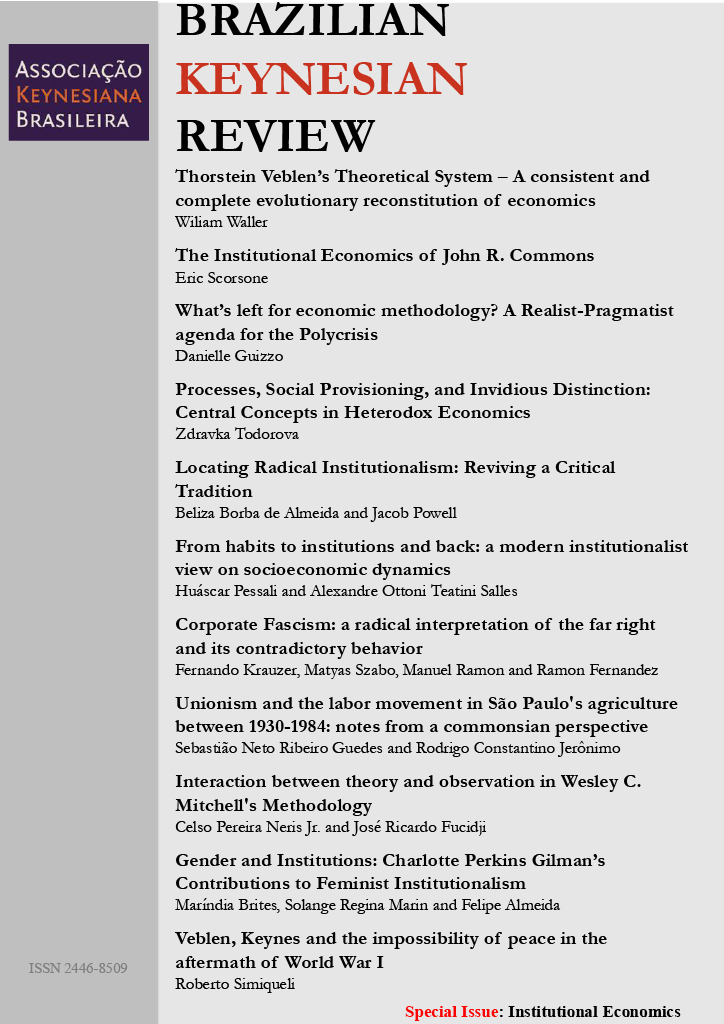
Editorial do Número Especial
Downloads
Referências
Almeida, Felipe and Sposito, Theodoro. 2024. “A Hidden Approach in the Origins of Post Keynesian Institutionalism” Paper presented during the XVII Meeting of the Brazilian Keynesian Association.
Arestis, Philip. 1992. The Post-Keynesian Approach to Economics. Aldershot: Edward Elgar.
Arestis, Philip. 1996. “Post-Keynesian Economics: Towards Coherence.” Cambridge Journal of Economics 20 (1): 111–135.
Cavalieri, Marco and Almeida, Felipe. 2017. “A History of the Foundation and the Early Years of AFEE: Pluralism and Eclecticism in Dissenting” Journal of Economic Issues 51(3): 613–634.
Dimand, Robert. 2004. “Interwar monetary and business cycle theory: Macroeconomics before Keynes” Research in the History of Economic Thought and Methodology, 21(Part 1): 121-148.
Fiorito, Luca and Vernengo, Matías. 2009. “The Other J.M.: John Maurice Clark and the Keynesian Revolution” Journal of Economic Issues 43 (4): 899–916.
Fucidji, José Ricardo; Neris Jr., Celso Pereira. 2026. “Another look at Wesley C. Mitchell’s economic methodology” Journal of Economic Issues, 60 (3): 748–764.
Hodgson, Geoffrey. 1989. “Post-Keynesianism and Institutionalism: The Missing Link.” In New Directions in Post-Keynesian Economics, edited by J. Pheby, 94–123. Aldershot: Edward Elgar.
Hodgson, Geoffrey. 1999. “Post-Keynesianism and Institutionalism: Another Look at the Link.” In Growth, Employment and Inflation: Essays in Honour of John Cornwall, edited by Mark Setterfield, 72–87. London: Macmillan.
Hodgson, Geoffrey. 2004. The Evolution of Institutional Economics: agency, structure and Darwinism in American institutionalism. London: Routledge.
Kaufman, Bruce. 2017. “The origins and theoretical foundation of Original Institucional Economics Reconsidered” Journal of the History of Economic Thought 39(3): 293-322.
King, John E. 2002. A History of Post Keynesian Economics since 1936. Cheltenham: Edward Elgar.
Lavoie, Marc. 2022. Post-Keynesian Economics: New Foundations. Cheltenham: Edward Elgar.
Morgan, Mary and Rutherford, Malcolm. 1998. “American Economics: The Character of the Transformation” History of Political Economy 30 (suplement): 1–26.
Neris Jr., Celso Pereira, and Rodrigo Constantino Jeronimo. 2025. “Commons Cited by Keynes: Intersections in the Reformist Mode of Thought.” Nova Economia 35 (3): 1-24.
Rutherford, Malcolm. 2011. The Institutionalist Movement in American Economics, 1918-1947: Science and Social Control. New York: Cambridge University Press.
Sposito, Theodoro. 2026. “The Hidden Institutional Architecture of Alfred Eichner’s Economics.” Review of Political Economy, preprint, April, 1–31.
Veblen, Thorstein. 1920. “Review of John Maynard Keynes’s The Economic Consequences of the Peace” Political Science Quarterly, 35(3): 467-472.
Whalen, Charles. 2008. “John R. Commons and John Maynard Keynes on economic history and policy: The 1920s and today” Journal of Economic Issues, 42 (1), 225-242.
Whalen, Charles. 2020. “Post-Keynesian Institutionalism: Past, Present, and Future.” Evolutionary and Institutional Economics Review, 17: 71–92.
Whalen, Charles. 2022a. “Grappling with an Ever-Changing Economy: The Evolution of Post-Keynesian Institutionalism.” In Institutional Economics: Perspectives and Methods in Pursuit of a Better World, edited by Charles Whalen. London (UK) and New York (US): Routledge.
Whalen, Charles. 2022b. Reforming Capitalism for the Common Good: Essays in Institutional and Post-Keynesian Economics. London (UK) and New York (US): Routledge.
Wilber, Charles, and Kenneth Jameson. 1983. An Inquiry into the Poverty of Economics. Notre Dame (US): University of Notre Dame Press.
Downloads
Publicado
Como Citar
Edição
Seção
Licença
Copyright (c) 2026 Felipe Almeida, Rodrigo Jeronimo

Este trabalho está licenciado sob uma licença Creative Commons Attribution 4.0 International License.
- Autores mantém os direitos autorais e concedem à revista o direito de primeira publicação, com o trabalho simultaneamente licenciado sob a Licença Creative Commons Attribution que permite o compartilhamento do trabalho com reconhecimento da autoria e publicação inicial nesta revista.
- Autores têm autorização para assumir contratos adicionais separadamente, para distribuição não-exclusiva da versão do trabalho publicada nesta revista (ex.: publicar em repositório institucional ou como capítulo de livro), com reconhecimento de autoria e publicação inicial nesta revista.
- Autores têm permissão e são estimulados a publicar e distribuir seu trabalho online (ex.: em repositórios institucionais ou na sua página pessoal) a qualquer ponto antes ou durante o processo editorial, já que isso pode gerar alterações produtivas, bem como aumentar o impacto e a citação do trabalho publicado (Veja O Efeito do Acesso Livre).