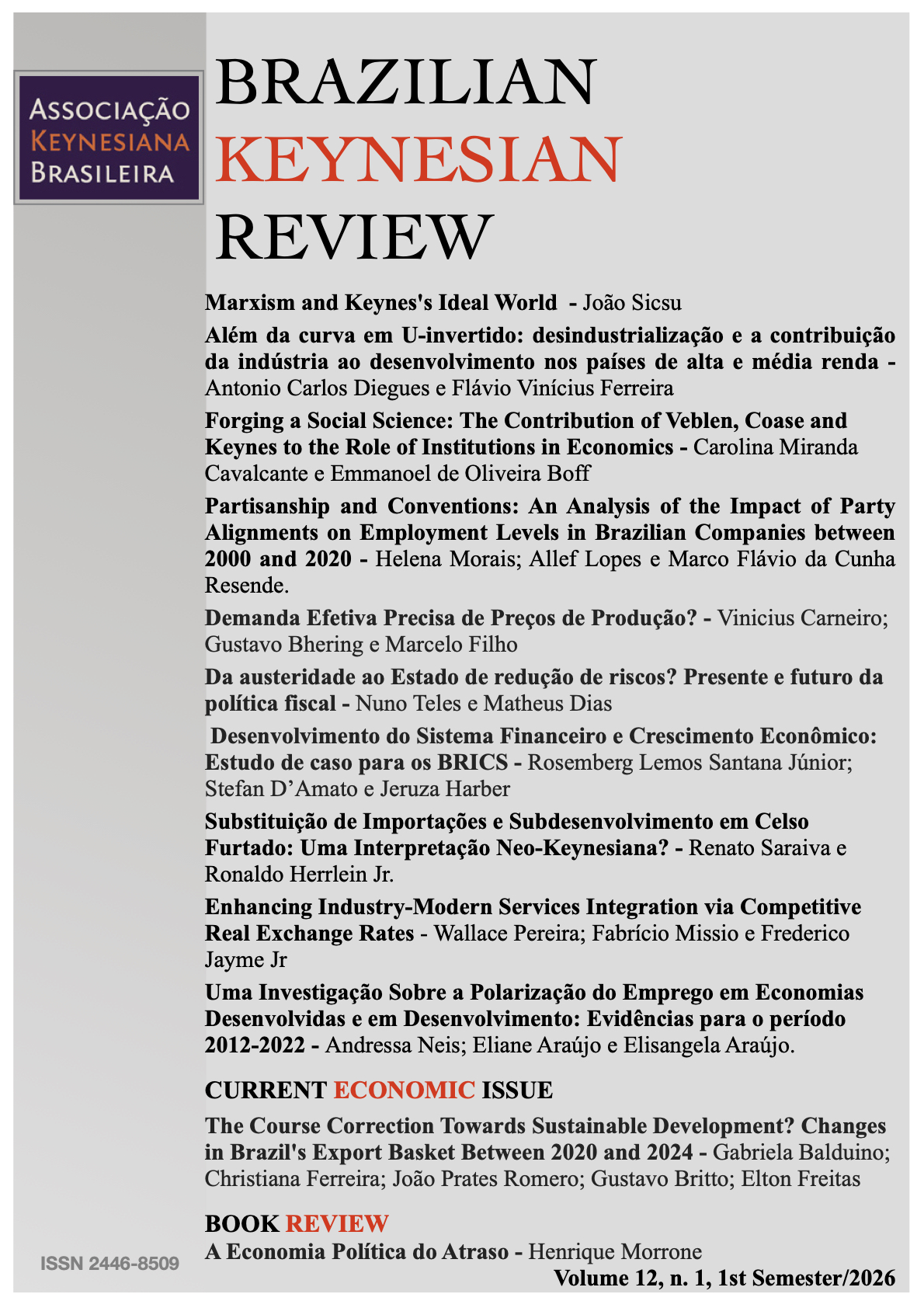
Partisanship and Conventions
An Analysis of the Impact of Party Alignments on Employment Levels in Brazilian Companies between 2000 and 2020
DOI:
https://doi.org/10.33834/bkr.v12i1.360Keywords:
Expectations, Conventions, Economic policy, Partisan Aligment, Political coordinationAbstract
The goal of this research is to examine the impact of political alignment among mayors, governors, and the President on local economic activity in Brazil, mainly focusing on labor demand by companies. This analysis is framed within the post-Keynesian school's concept of conventions. The paper provides an overview of post-Keynesian literature discussing the development of conventions and their implications for modern economies. The methodology involves empirical studies demonstrating that political alignments are likely to have a positive effect on variations in the formal employment rate at the level of individual firms. The findings indicate that examining conventions offers a valuable understanding of the uncertainties and complexities inherent in economic decision-making processes at the microeconomic level. This is especially pertinent in the Brazilian context, where political affiliations significantly influence the formation of regional economic conventions. Overall, this study sheds light on the determinants of employment levels in Brazilian companies and underscores the critical role of political coordination in the promotion of economic stability by mitigating uncertainty and fostering the emergence of optimistic economic conventions.
Downloads
References
Abrucio, F. L., & Franzese, C. (2007). Federalismo e políticas públicas: o impacto das relações intergovernamentais no Brasil. Tópicos de Economia Paulista para Gestores Públicos, 1, 13–31.
Affonso, R. (1996). Os municípios e os desafios da federação no Brasil. São Paulo em Perspectiva, 10, 3–10.
Angrist, J. D., & Krueger, A. B. (1999). Empirical strategies in labor economics. In Handbook of Labor Economics (Vol. 3, pp. 1277–1366). Elsevier. DOI: 10.1016/S1573-4463(99)03004-7
Arestis, P., Filho, F. F., Resende, M. F., & Terra, F. B. (2019). Brazilian monetary and fiscal policies from 2011 to 2017: conventions and crisis. Challenge, 62, 187–199. DOI: 10.1080/05775132.2019.1606540
Baltagi, B. H., & Liu, L. (2020). Forecasting with unbalanced panel data. Journal of Forecasting, 39, 709–724. DOI: 10.1002/for.2646
Battese, G. E., & Coelli, T. J. (1995). A model for technical inefficiency effects in a stochastic frontier production function for panel data. Empirical Economics, 20, 325–332.
Botte, F. (2019). Endogenous business cycles and Harrodian instability in an agent-based model. Journal of Post Keynesian Economics, 42, 232–254. DOI: 10.1080/01603477.2018.1486206
Bresser-Pereira, L. C. (1976). Da macroeconomia clássica à keynesiana. São Paulo.
Campos, M. M. S., & Chiarini, T. (2014). Incerteza e não ergodicidade: crítica aos neoclássicos. Brazilian Journal of Political Economy, 34, 294–316. DOI: 10.1590/S0101-31572014000200008
Carvalho, F. J. (1988). Keynes, a instabilidade do capitalismo e a teoria dos ciclos econômicos.
Carvalho, F. J. C. (2014). Expectativas, incerteza e convenções. In D. Monteiro Filha, L. C. Prado, & H. Lastres (Orgs.), Estratégias de desenvolvimento, política industrial e inovação: ensaios em memória de Fabio Erber. Rio de Janeiro: Banco Nacional de Desenvolvimento Econômico e Social.
Castro, L. B. de. (2019). Macroeconomia moderna: lições de Keynes para economias em desenvolvimento. Brazilian Keynesian Review, 5, 351–356.
Chaib, D. C., & Lima, D. J. P. (2019). Instabilidade econômica em Keynes: elementos para a análise dos efeitos da crise de 2008 sobre a economia brasileira. Economia e Desenvolvimento, 31, 1–11. DOI: 10.5902/1414650935695
Corsi, F., & Sornette, D. (2014). Follow the money: The monetary roots of bubbles and crashes. International Review of Financial Analysis, 32, 47–59. DOI: 10.1016/j.irfa.2014.01.007
Dequech, D. (2000). Fundamental uncertainty and ambiguity. Eastern Economic Journal, 26, 41–60.
Dequech, D. (2022). Conventions in Keynes’s theory of goods markets: investment and production decisions. Journal of Post Keynesian Economics, 45, 145–167. DOI: 10.1080/01603477.2021.1913753
Erber, F. S. (2011). As convenções de desenvolvimento no governo Lula: um ensaio de economia política. Brazilian Journal of Political Economy, 31, 31–55. DOI: 10.1590/S0101-31572011000100002
Fardoust, S., & Ravishankar, V. (2013). Subnational fiscal policy in large developing countries: Some lessons from the 2008–09 crisis for Brazil, China and India. World Bank Policy Research Working Paper.
Farmer, R. E. (2017). Post-Keynesian dynamic stochastic general equilibrium theory. European Journal of Economics and Economic Policies: Intervention, 14, 173–185. DOI: 10.4337/ejeep.2017.02.02
Fazzari, S., Ferri, P., & Greenberg, E. (2008). Cash flow, investment, and Keynes-Minsky cycles. Journal of Economic Behavior & Organization, 65, 555–572. DOI: 10.1016/j.jebo.2005.11.007
Fernandes, F. M. B., & Mafort-Ouverney, A. L. (2022). Decisões do Supremo Tribunal Federal no início da pandemia de Covid-19: impactos no federalismo brasileiro? Saúde em Debate, 46, 48–61. DOI: 10.1590/0103-11042022E103
Ferrari Filho, F., & Terra, F. (2011). As disfunções do capitalismo na visão de Keynes e suas proposições reformistas. Revista de Economia Contemporânea, 15, 271–295. DOI: 10.1590/S1415-98482011000200003
Fleming, D. A., & Measham, T. G. (2014). Local job multipliers of mining. Resources Policy, 41, 9–15. DOI: 10.1016/j.resourpol.2014.02.005
Fraga, J. S., & Resende, M. F. C. (2022). Infrastructure, conventions and private investment: An empirical investigation. Structural Change and Economic Dynamics, 61, 351–361. DOI: 10.1016/j.strueco.2022.03.006
Keynes, J. M. (1973). The General Theory and After: Defence and Development (Vol. XIV, The Collected Writings of John Maynard Keynes). London: Macmillan/Royal Economic Society.
Keynes, J. M. (1988). A teoria geral do emprego, do juro e da moeda. São Paulo: Nova Cultural.
Keynes, J. M. (2013). A Treatise on Probability (Vol. VIII, The Collected Writings of John Maynard Keynes). Cambridge: Cambridge University Press.
Libanio, G. A., Resende, M. F., Cardoso, D. F., & Montenegro, R. L. G. (2020). Atividade econômica e inovação na indústria brasileira: uma análise com dados em painel (2010–2016). Brazilian Keynesian Review. DOI: 10.33834/bkr.v6i1.177
Margo, R. A. (1993). Employment and unemployment in the 1930s. Journal of Economic Perspectives, 7, 41–59.
de Melo Modenesi, A., Modenesi, R. L., Oreiro, J. L., & Martins, N. M. (2013). Convention, interest rates and monetary policy: a post-Keynesian–French-conventions-school approach. European Journal of Economics and Economic Policies, 10, 76–92. DOI: 10.4337/ejeep.2013.01.07
Moretti, E. (2010). Local multipliers. American Economic Review, 100, 373–377. DOI: 10.1257/aer.100.2.373
Moretti, E., & Thulin, P. (2013). Local multipliers and human capital in the United States and Sweden. Industrial and Corporate Change, 22, 339–362. DOI: 10.1093/icc/dts051
Nader, G. (2018). A economia política da política monetária no Primeiro Governo Dilma: uma análise sobre taxa de juros, convenção e rentismo no Brasil. Economia e Sociedade, 27, 547–575. DOI: 10.1590/1982-3533.2017v27n2art7
Oreiro, J. L., Nakabashi, L., & Souza, G. J. G. (2010). A economia brasileira puxada pela demanda agregada. Brazilian Journal of Political Economy, 30, 581–603. DOI: 10.1590/S0101-31572010000400003
O’Sullivan, M. (2009). Finance and innovation. In J. Fagerberg & D. C. Mowery (Orgs.), The Oxford Handbook of Innovation. Oxford: Oxford University Press.
Palley, T. I. (1997). Expected aggregate demand, the production period and the Keynesian theory of aggregate supply. The Manchester School, 65, 295–309. DOI: 10.1111/1467-9957.00058
Plihon, D. (1995). A ascensão das finanças especulativas. Economia e Sociedade, 4, 61–78.
Resende, M. F. C., & Terra, F. H. B. (2020). Ciclo, crise e retomada da economia brasileira: avaliação macroeconômica do período 2004–2016. Economia e Sociedade, 29, 469–496. DOI: 10.1590/1982-3533.2020v29n2art05
Resende, M. F. C. (2023). Conventions and the Brazilian fiscal policy to face the aftermath of the COVID-19 economic crisis: a Post Keynesian view. Economic Issues, 28.
Resende, M. F. C., Terra, F. H. B., & Ferrari Filho, F. (2021). Conventions, money creation and public debt to face the Covid-19 crisis and its aftermath: A Post-Keynesian view. Brazilian Journal of Political Economy, 41, 254–270. DOI: 10.1590/0101-31572021-3260
Sakurai, S. N., & Theodoro, M. (2020). On the relationship between political alignment and government transfers: triple differences evidence from a developing country. Empirical Economics, 58(3), 1107–1141.
Santos, R. S. (2005). Municipal power: participation, decentralization, and innovative public policies. Revista de Administração Pública, 39, 703.
Terra, F. H. B., & Goudard, G. C. (2018). Incerteza, tomada de decisão, hábito e instituição: uma possível articulação entre keynesianos e neoinstitucionalistas. Economia e Sociedade, 27, 713–742. DOI: 10.1590/1982-3533.2018v27n3art01
Verbeek, M. (2021). Panel methods for finance: A guide to panel data econometrics for financial applications. Berlin: De Gruyter. DOI: 10.1515/9783110660739
Wooldridge, J. M. (2009). Econometrics: Panel Data Methods. Cambridge, MA: MIT Press.
Downloads
Published
How to Cite
Issue
Section
License
Copyright (c) 2026 Helena Morais, Aleff Lopes, Marco Flávio da Cunha Resende

This work is licensed under a Creative Commons Attribution 4.0 International License.
- Authors keep copyrights and concede to the Journal the right to the first publication, with the paper simultaneously licenced under the Creative Commons Attribution 4.0 International License which allows recognised author and journal work sharing.
- Authors are authorized to assume additional contracts separately, for non-exclusive versions of the paper published in this journal (e.g.: publish in an instituional repository or as a book chapter) with the recogntion of authorship and initial publication in this journal.
- Authors are allowed (and are estimulated) to publish and distribute their work online (e.g.: in institutional repositories or at their personal websites) at any point before or during the editorial process, once this may generate productive alterations on the paper, as well as increse the factor of impact and quotation of the published paper (please, see Free Access Effect)