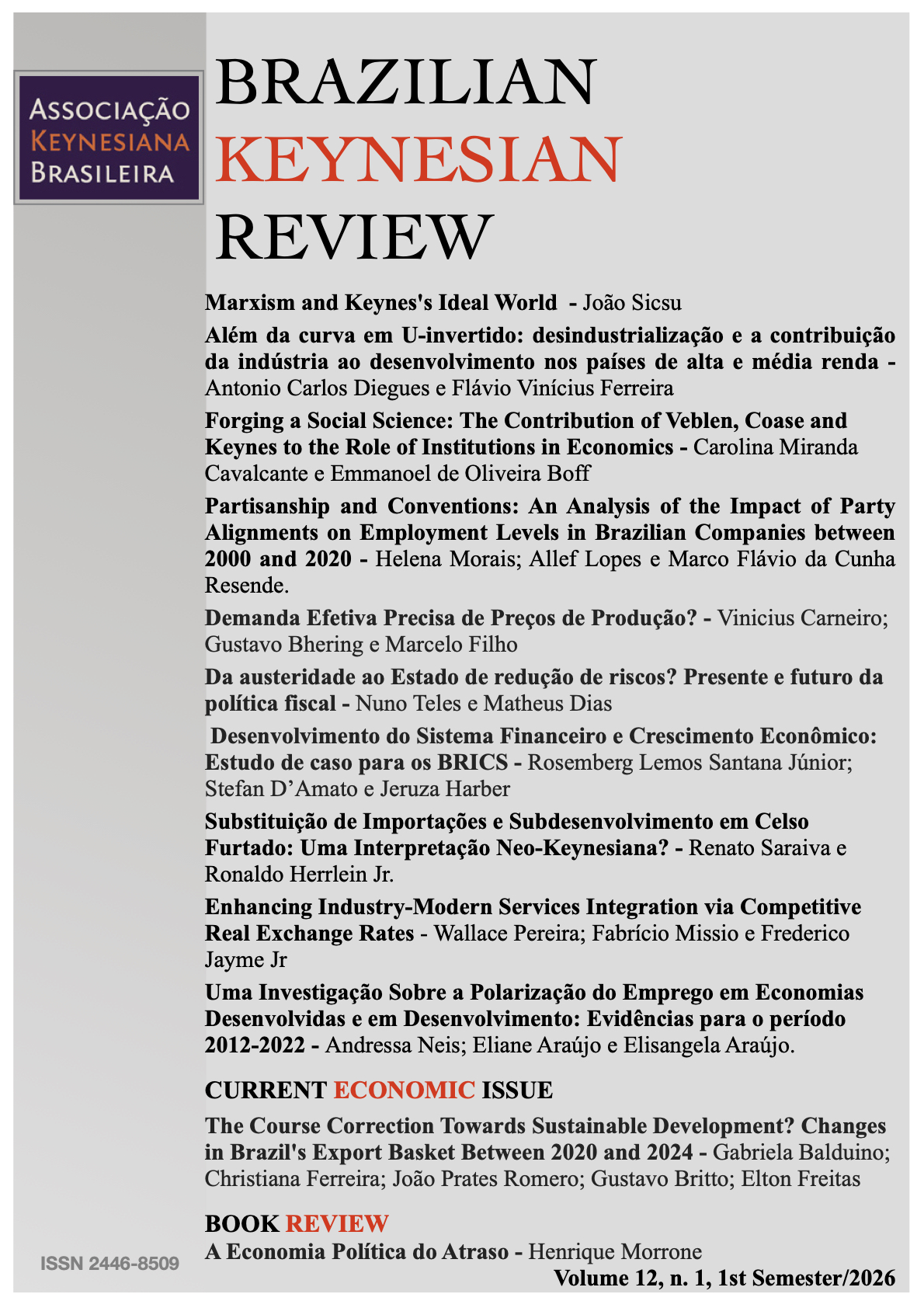
Enhancing Industry-Modern Services Integration via Competitive Real Exchange Rates
DOI:
https://doi.org/10.33834/bkr.v12i1.406Keywords:
Manufacturing, Services, Real Exchange Rate, Economic Growth, Increasing Returns to ScaleAbstract
This article discusses theoretically the role of the Real Exchange Rate (RER) on the integration of manufacturing and modern services sectors. It explains how deindustrialization has elevated the significance of modern services, which are critical for productivity and innovation. The symbiotic relationship between both sectors is a vital force that induces pro-growth structural economic change. We demonstrate how competitive RER encourages structural adjustments and investments, promoting interaction between the manufacturing and services sectors, particularly in developing economies, thereby enhancing global competitiveness. In a two-cycle process, a competitive RER initially boosts profitability and external competitiveness, leading to increased automation and collaboration with modern services. This interaction catalyzes "amplified dynamic increasing returns to scale," driven by shared innovations. Over time, as sectors reap profits, they deepen their integration, improve products, and broaden market access. Consequently, the RER fosters a symbiotic relationship that is essential for sustainable economic development and competitiveness in international trade.
Downloads
References
Alfaro, L., Cuñat, A., Fadinger, H., & Liu, Y. (2018). The Real Exchange Rate, Innovation and Productivity: Heterogeneity, Asymmetries and Hysteresis (No. w24633). National Bureau of Economic Research. DOI: 10.3386/w24633.
Alimi, N. (2025). Real exchange rate changes and employment in emerging economies: Sectorial analysis. The Japanese Political Economy, 1-19. DOI: 10.1080/2329194X.2025.2469262
Arbache, J. (2014) Serviços e Competitividade Industrial no Brasil, Confederação Nacional da Indústria, Brasília.
Arend, M. (2015). A industrialização do Brasil ante a nova divisão internacional do trabalho. In A. Biancarelli, A. Calixtre, & M. Cintra (Orgs.), Presente e futuro do desenvolvimento brasileiro. IPEA.
Ariu, A., Breinlich, H., Corcos, G., & Mion, G. (2019). The interconnections between services and goods trade at the firm-level. Journal of International Economics, 116, 173–188. DOI: 10.1016/j.jinteco.2018.10.005
Ark, B. V., Inklaar, R., & McGuckin, R. H. (2003). ICT and Productivity in Europe and the United States (No. 200311). University of Groningen, CCSO Centre for Economic Research. DOI: 10.1093/cesifo/49.3.295
Ascani, A., & Iammarino, S. (2018). Multinational enterprises, service outsourcing and regional structural change. Cambridge Journal of Economics, 42(6), 1585–1611. DOI: 10.1093/cje/bey036
Baggs, J., Beaulieu, E., & Fung, L. (2010). Are service firms affected by exchange rate movements? Review of Income and Wealth, 56, S156–S176. DOI: 10.1111/j.1475-4991.2010.00389.x
Balassa, B. (1964). The purchasing-power parity doctrine: a reappraisal. Journal of Political Economy, 72(6), 584–596. DOI: 10.1086/258965
Barreto, L., Amaral, A., & Pereira, T. (2017). Manufacturing 4.0 implications in logistics: an overview. Procedia Manufacturing, 13, 1245–1252. DOI: 10.1016/j.promfg.2017.09.045
Baumol, W. J. (1967). Macroeconomics of unbalanced growth: the anatomy of urban crisis. American Economic Review, 57(3), 415–426. http://www.jstor.org/stable/1812111
Bell, M., & Pavitt, K. (1993). Accumulating technology captivity in developing countries. Industrial and Cooperative Change, 2(2), 35–44. DOI: 10.1093/wber/6.suppl_1.257
Blecker, R. (2021). New advances and controversies in the framework of balance-of-payments-constrained growth. Journal of Economic Surveys, special issue, pp. 1-39. DOI: 10.1111/joes.12463
Browning, H. L., & Singelmann, J. (1978). The transformation of the US labor force: the interaction of industry and occupation. Politics & society, 8(3-4), 481-509. DOI: 10.1177/003232927800800306
Cadestin, C., & Miroudot, S. (2020). Services exported together with goods. OECD Trade Policy Papers, No. 236, OECD Publishing, Paris, DOI: 10.1787/275e520a-en.
Cainelli, G., & Mazzanti, M. (2013). Environmental innovations in services: Manufacturing services integration and policy transmissions. Research Policy, 42(9), 1595–1604. DOI: 10.1016/j.respol.2013.05.010
Castellacci, F. (2008). Technological paradigms, regimes and trajectories: Manufacturing and service industries in a new taxonomy of sectoral patterns of innovation. Research Policy, 37(6–7), 978–994. DOI: 10.1016/j.respol.2008.03.011
Clark, C. (1967). The Conditions of Economic Progress. London: MacMillan.
Comin, D., Lashkari, D., & Mestieri, M. (2021). Structural change with long‐run income and price effects. Econometrica, 89(1), 311-374 DOI: 10.3982/ECTA16317
Dao, M. C., Minoiu, M. C., & Ostry, M. J. D. (2017). Corporate Investment and the Real Exchange Rate. International Monetary Fund. DOI: 10.1016/j.jinteco.2021.103437
Dasgupta, S., & Singh, A. (2006). Manufacturing, services and premature deindustrialization in developing countries: A Kaldorian analysis (No. 2006/49). Research Paper, UNU-WIDER, United Nations University (UNU). DOI: 10.1057/9780230801462_23
Demir, F., and Razmi, A. (2021). The real exchange rate and development theory, evidence, issues and challenges. Journal of Economic Surveys, 0, pp. 1-43. DOI: 10.1111/joes.12418
Dhasmana, A. (2015). Transmission of real exchange rate changes to the manufacturing sector: The role of financial access. International Economics, 143, 48–69. DOI: 10.1016/j.inteco.2015.04.006
Di Berardino, C., & Onesti, G. (2018). The two-way integration between manufacturing and services. The Service Industries Journal, 40(5–6), 337–357. DOI: 10.1080/02642069.2018.1438415
Di Meglio, G., Gallego, J., Maroto, A., & Savona, M. (2018). Services in developing economies: the deindustrialization debate in perspective. Development and Change, 49(6), 1495–1525. DOI:10.1111/dech.12444
Di Meglio, G., Gallego, J. (2022). Disentangling services in developing regions: A test of Kaldor's first and second laws. Structural Change and Economic Dynamics, 60, 221-229. DOI: 10.1016/j.strueco.2021.11.007
Dominiak, J. (2018). Modern services: terminological considerations and the characteristic features of their role in socio-economic development. DOI: 10.2478/quageo-2018-0020
Dunning, J. H. (1989). Multinational enterprises and the growth of services: some conceptual and theoretical issues. The Service Industries Journal, 9(1), 5–39. DOI: 10.1080/02642068900000002
Eichengreen, B., & Gupta, P. (2013). The Real Exchange Rate and Export Growth: Are Services Different? The World Bank.
Eichengreen, B., & Gupta, P. (2013a): The two waves of service sector growth. NBER. Working Paper, no. 14968. DOI: 10.1093/oep/gpr059
Engelbrecht, H. J. (1992). New perspectives on intersectorial relationships between manufacturing and services. Economics of Planning, 25(2), 165–178. DOI: 10.1007/BF00373065
Frenkel, R., and Ros, J. (2006). Unemployment and the real exchange rate in latin america. World Development, 34(4), pp. 631-646. DOI: 10.1016/j.worlddev.2005.09.007
Fuchs, V. R. (1965). The growing importance of the service industries. The Journal of Business, 38(4), 344–373. http://www.jstor.org/stable/2351716
Gabriel, L. F., & Missio, F. J. (2018). Real exchange rate and economic complexity in a North-South structuralist BoPG model. PSL Quarterly Review, 71(287), 439–465. DOI: 10.13133/2037-3643_71.287_4
Gabriel, L. F., Ribeiro, L. C. D. S., Jayme Jr, F. G., & Oreiro, J. L. (2020). Manufacturing, economic growth, and real exchange rate: Empirical evidence in panel data and input-output multipliers. PSL Quarterly Review, 73(292), 51–75. DOI: doi:10.13133/2037-3643_73.292_3
Gallego, J., & Maroto, A. (2015). The specialization in knowledge-intensive business services (KIBS) across Europe: Permanent co-localization to debate. Regional Studies, 49(4), 644–664. DOI: 10.1080/00343404.2013.799762
Giovanini, A., & Arend, M. (2017). Contribution of services to economic growth: Kaldor’s fifth law. RAM. Revista de Administração Mackenzie, 18(4), 190–213. DOI: 10.1590/1678-69712017/administracao.v18n4p190-213
Giovanini, A., & Arend, M. (2019). Simbiose entre indústria e serviços intermediários: a mudança na dinâmica setorial contemporânea brasileira. Revista de Economia, 39(68). DOI: 10.5380/re.v39i68.61145
Giovanini, A., Pereira, W. M., & Saath, K. C. D. O. (2020). Intermediate services’ impact on capital goods production. Nova Economia, 30(1), 203–230. DOI: 10.1590/0103-6351/4572
Goda, T., Torres García, A., & Larrahondo, C. (2024). Real exchange rates and manufacturing exports in emerging economies: the role of sectoral heterogeneity and product complexity. Review of World Economics, 160(3), 1057-1082. DOI: 10.1007/s10290-023-00523-3
Guzman, M., Ocampo, J. A., & Stiglitz, J. E. (2018). Real exchange rate policies for economic development. World Development, 110, 51–62. DOI: 10.1016/j.worlddev.2018.05.017
Habib, M. M., Mileva, E., & Stracca, L. (2017). The real exchange rate and economic growth: Revisiting the case using external instruments. Journal of International Money and Finance, 73, 386–398. DOI: 10.1016/j.jimonfin.2017.02.014
Hauknes, J. (1998). Services in innovation–Innovation in services (No. 199813). The STEP Group, Studies in technology, innovation and economic policy.
Hertog, P. D. (2000) Knowledge-intensive business services as co-producers of innovation. International Journal of Innovation Management, 4(4), 491–528. DOI: 10.1142/S136391960000024X
Hunegnaw, F. B. (2017). Real exchange rate and manufacturing export competitiveness in Eastern Africa. Journal of Economic Integration, 32 (4): 891–912. DOI: 10. 1 1 130/jei.201 7.32.
Iasco-Pereira, H. C., Libânio, G., & Missio, F. (2024). The real exchange rate and industrial investment: new evidence for Brazil. Cambridge Journal of Economics, 48(4), 741-766. DOI: 10.1093/cje/beae020
Karaomerioglu, D. C., & Carlaaon, B. (1999). Manufacturing in decline? A matter of definition. Economy, Innovation, New Technology, 8, 175–196. DOI: 10.1080/10438599900000008
Kon, A. (2006). O comércio internacional da indústria de serviços: os impactos no desenvolvimento de países da América. Brazilian Journal of Latin American Studies, 5(9), 09-47. DOI: 10.11606/issn.1676-6288.prolam.2006.81806
Las Casas, A. L. (1991). Marketing de serviços. Editora Atlas.
Leon-Ledesma, M., & Moro, A. (2020). The rise of services and balanced growth in theory and data. American Economic Journal: Macroeconomics, 12(4), 109-46. DOI: 10.1257/mac.20180373
Levy-Yeyati, E. & Sturzenegger, F. (2009) Fear of appreciation: exchange rate policy as a development strategy. In Hammond, G., Kanbur, R., & Prasad, E. (Eds.), Monetary Policy Frameworks for Emerging Markets. Edward Elgar Publishing, pp. 69–94. DOI: 10.4337/9781848449190.00010
Lima, G. T., & Porcile, G. (2013). Economic growth and income distribution with heterogeneous preferences on the real exchange rate. Journal of Post Keynesian Economics, 35(4), 651–674. DOI: 10.2753/PKE0160-3477350407
Machado, A., Arbache, J., & Moreira, R. (2015). Classificações das atividades de serviços (Nota técnica). Economia de Serviços. Available in: https://economiadeservicos.com/wpcontent/uploads/2015/09/NotaT%C3%A9cnica-Classifica%C3%A7%C3%B5es.pdf
Mahalik, M. K., & Pal, S. (2024). Factors Affecting Traditional and Modern Services Imports in an Emerging Economy: The Role of Real Exchange Rate and Remittances Inflows. The Indian Economic Journal, 0(0). DOI: 10.1177/00194662241265485
Marshall, J. N. Services and Uneven Development. New York: Oxford University Press, 1988.
Mazorodze, B. T., & Tewari, D. D. (2018). Real exchange rate undervaluation and sectoral growth in South Africa. African Journal of Economic and Management Studies, 4(4), 462–476. DOI: 10.1108/AJEMS-06-2017-0132
Miles, I. (2008). Patterns of innovation in service industries. IBM Systems Journal, 47(1), 115. DOI: 10.1147/sj.471.0115
Miozzo, M., & Soete, L. (2001). Internationalization of services: a technological perspective. Technological Forecasting and Social Change, 67(2-3), 159-185. DOI: 10.1016/S0040-1625(00)00091-3
Mishra, Saurabh; Lundstrom, Susanna; Anand, Rahul. 2011. Service Export Sophistication and Economic Growth. Policy Research working paper ; no. WPS 5606. © World Bank. http://hdl.handle.net/10986/3372
Missio, F., Jayme Jr., F. G. (2012). Structural heterogeneity and endogeneity of elasticities on the balance of payments constrained growth model. In: Souziakis, E. & Cerqueira, P. (Eds.). Models of Balance of Payments Constrained Growth (vol. 1), first ed. London: Palgrave, pp. 239–267. DOI: 10.1057/9781137023957_10
Missio, F. J., Jayme Jr, F. G., & Conceição, O. A. (2015). O problema das elasticidades nos modelos de crescimento com restrição externa: Contribuições ao debate. Estudos Econômicos (São Paulo), 45(2), 317–346. DOI: 10.1590/0101-4161201545233ffo
Nassif, A., Feijó, C. A., & Araújo, E. (2017). A structuralist-Keynesian model for determining the optimum real exchange rate for Brazil’s economic development process: 1999–2015. CEPAL Review. DOI: 10.18356/f7f73b44-en
Nusbaumer, J. (1984). Les services: Nouvelle donne de l’économie. Economica.
Palma, J. G. (2005). Quatro fontes de desindustrialização e um novo conceito de doença holandesa. In: Conferência de industrialização, desindustrialização e desenvolvimento. Centro Cultural da Fiesp.
Panda, AK & Nanda, S 2019, 'The nexus between exchange rate and long-term investment in Indian manufacturing industry', Management Research Review, 42, 174-198. DOI: 10.1108/MRR-01-2018-0024
Park, S. H. (1994). Intersectoral relationships between manufacturing and services: new evidence from selected Pacific Basin countries. ASEAN Economic Bulletin, 10 (3). 245-263. https://www.jstor.org/stable/25770495
Pattichis, C. (2012). Exchange rate effects on trade in services. Journal of Economic Studies, 39(6), 697–708. DOI: 10.1108/01443581211274629
Pereira, W., Missio, F., & Jayme Jr, F. (2024). Structural Change in the 21st Century: The Role of the Modern Services Sector in the Economic Development Strategy. Review of Political Economy, 1-25. DOI: 10.1080/09538259.2024.2342431
Pereira, W. M., Missio, F. J., & Jayme Jr, F. G. (2025). Modern services, real exchange rate and economic growth. Brazilian Journal of Political Economy, 45(1), e253562. DOI: 10.1590/0101-31572025-3562
Porcile, G., Spinola, D., & Yajima, G. (2020). Patterns of Growth in Structuralist Models: The Role of the Real Exchange Rate and Industrial Policy (No. 2020-027). United Nations University – Maastricht Economic and Social Research Institute on Innovation and Technology (MERIT).
OECD (2000). The Service Economy, OECD Publishing, Paris, DOI: 10.1787/9789264182516-en.
OECD (2005), “Growth in Services - Fostering Employment, Productivity and Innovation”, OECD Digital Economy Papers, No. 94, OECD Publishing, Paris. DOI: 10.1787/232370436752
Rapetti, M. (2016). The real exchange rate and economic growth: some observations on the possible channels. In: Damill, M., Rapetti, M., & Rozenwurcel, G. (Eds.), Macroeconomics and Development. DOI: 10.7312/dami17508-014
Rapetti M. (2020). The real exchange rate and economic growth: A survey. Journal of Globalization and Development, 11(1), 1–054. DOI: 10.1515/jgd-2019-0024
Razmi, A., Rapetti, M., & Skott, P. (2012). The real exchange rate and economic development. Structural Change and Economic Dynamics, 23(2), 151–169. DOI: 10.1016/j.strueco.2012.01.002
Roach, S. S. (1988). Technology and the services sector: The hidden competitive challenge. Technological Forecasting and Social Change, 34(4), 387–403. DOI: 10.1016/0040-1625(88)90006-6
Rodrik, D. (2008). The real exchange rate and economic growth. Brookings Papers on Economic Activity, 2008(2), 365–412. DOI: 10.1353/eca.0.0020.
Rodrik, D. (2016). Premature deindustrialization. Journal of Economic Growth, 21(1), 1–33. DOI: 10.1007/s10887-015-9122-3
Rodrigues, R. L. (2024) Ensaios sobre Serviços e Crescimento Econômico. 2024. 131f. Tese (Doutorado) Curso de Programa de Pós-Graduação em Economia, Universidade Federal de Uberlândia, Uberlândia.
Rowthorn, R. E., & Wells, J. R. (1987), De-industrialization and Foreign Trade. Cambridge: Cambridge University Press.
Rowthorn, R., & Ramaswamy, R. (1997). Deindustrialization: Its Causes and Implications (Vol. 10). Washington, DC: International Monetary Fund.
Rowthorn, R., & Ramaswamy, R. (1999). Growth, trade, e deindustrialization. IMF Staff papers, 46 (1), 18-41. Sahoo, M., Babu, M. S., & Dash, U. (2019). Asymmetric effects of exchange rate movements on traditional and modern services exports: Evidence from a large emerging economy. The Journal of International Trade & Economic Development, 28(4), 508–531. DOI: 10.1080/09638199.2018.1561744
Samuelson, P. A. (1964). Theoretical notes on trade problems. The Review of Economics and Statistics, 46 (2): 145–154. DOI: 10.2307/1928178
Silvestro, R., Fitzgerald, L., & Johnston, R. (1992). Towards a classification of service processes. International Journal of Service Industry Management, 3(3), 62–75. DOI: 10.1108/09564239210015175
Tregenna, F. (2009). Characterising deindustrialisation: An analysis of changes in manufacturing employment and output internationally. Cambridge Journal of Economics, 33(3), 433–466. DOI: 10.1093/cje/ben032
Tregenna, F. (2016). Deindustrialisation and premature deindustrialisation. In Ghosh, J., Kattel, R., Reinert, E., (Eds.), Elgar handbook of alternative theories of economic development, Edward Elgar, Cheltenham. DOI: 10.4337/9781782544685.00046
Unctad. (2017). The role of the services economy and trade in structural transformation and inclusive development. Geneva: Trade and Development Board.
Unctad. (2022). World Investment Report 2022: International tax reforms and sustainable investment. United Nations.
United Nations, Department of Economic and Social Affairs, Statistics Division. (2002). International standard industrial classification of all economic activities: ISIC Rev. 3.1 (Draft ESA/STAT/SER.M/4/Rev.3.1, updated February 21, 2002). United Nations. https://unstats.un.org/unsd/statcom/doc02/isic.pdf
Vaz, P., and Baer, W. (2014). Real exchange rate and manufacturing growth in Latin America. Latin American Economic Review, 24(2), pp. 1-17. DOI: 10.1007/s40503-014-0002-6
Downloads
Published
How to Cite
Issue
Section
License
Copyright (c) 2026 Wallace Marcelino Pereira, Fabrício José Missio, Frederico Gonzaga Jayme Jr

This work is licensed under a Creative Commons Attribution 4.0 International License.
- Authors keep copyrights and concede to the Journal the right to the first publication, with the paper simultaneously licenced under the Creative Commons Attribution 4.0 International License which allows recognised author and journal work sharing.
- Authors are authorized to assume additional contracts separately, for non-exclusive versions of the paper published in this journal (e.g.: publish in an instituional repository or as a book chapter) with the recogntion of authorship and initial publication in this journal.
- Authors are allowed (and are estimulated) to publish and distribute their work online (e.g.: in institutional repositories or at their personal websites) at any point before or during the editorial process, once this may generate productive alterations on the paper, as well as increse the factor of impact and quotation of the published paper (please, see Free Access Effect)